Denmark votes in election shaped by Trump's Greenland threat
Danish voters cast ballots Tuesday in a parliamentary election where Prime Minister Mette Frederiksen seeks a third term, boosted by her defiant stance against U.S. pressure over Greenland.
10:43 AM
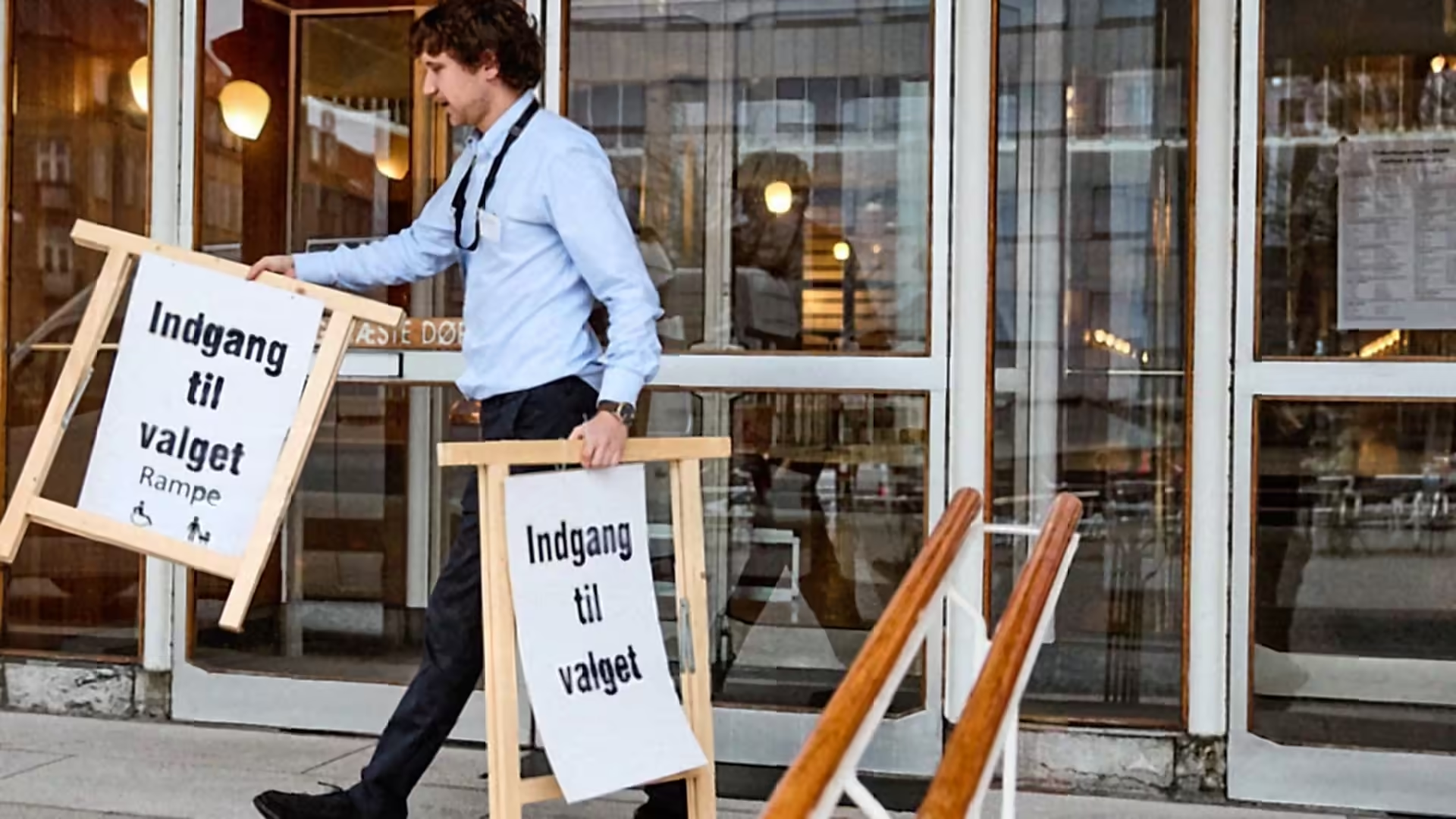
Danish voters went to the polls Tuesday in a parliamentary election that has been significantly shaped by U.S. President Donald Trump's efforts to acquire Greenland, a semi-autonomous Danish territory in the Arctic.
About 4.3 million Danes were registered to vote. Polling stations opened at 8 a.m. local time and closed at 8 p.m., with exit poll results expected in the evening.
Prime Minister Mette Frederiksen, 48, a Social Democrat, is seeking a third term in office. She called the election several months before an October deadline, a timing observers attributed to her careful calculation of political momentum. Frederiksen's popularity had declined during her second term due to rising costs of living and public discontent over tough asylum reforms. However, her standing recovered significantly after she publicly resisted Trump's pressure to cede control of Greenland.
According to polling data, the Social Democrats stood at 21 percent support, up from a December low of 17 percent. Frederiksen has become one of the most dominant forces in Danish politics in recent decades, with many Danes referring to her simply by her first name.
Her main challenger is Troels Lund Poulsen, the centre-right Defence Minister from the Venstre party, who has emerged as a key rival during the campaign. Another centre-right opponent is Alex Vanopslagh of the Liberal Alliance, who recently admitted to cocaine use during his time as party leader.
Denmark's political landscape is complex, with more than 10 political parties typically organized into "red" and "blue" blocs. The red, left-wing bloc includes the Social Democrats, the Danish Social Liberal Party, the Green Left, and the Red-Green Alliance. The blue, right-wing bloc comprises Venstre, the Danish People's Party, the Conservative People's Party, the Liberal Alliance, and Nye Borgerlige.
After the 2022 election, the Social Democrats broke with convention by forming a centrist coalition government with the centre-right Moderates and Venstre, rather than pursuing a traditional left-wing red bloc coalition. This time, most red bloc parties are hoping to form a traditional left-wing coalition to advance a stronger left-wing agenda. However, with polls showing tight races, the Moderates are expected to play a decisive "kingmaker" role in post-election coalition negotiations.
Denmark has among the highest living standards in the world and a population of six million. The country has been part of the Kingdom of Denmark for more than 300 years, with Greenland remaining a semi-autonomous territory under Danish sovereignty.
Trump had threatened to take control of Greenland earlier this year before later backing off those threats. The issue has remained prominent in Danish public consciousness and shaped the election campaign, with campaign posters covering city walls, parks, and lamp posts throughout Copenhagen and other areas.