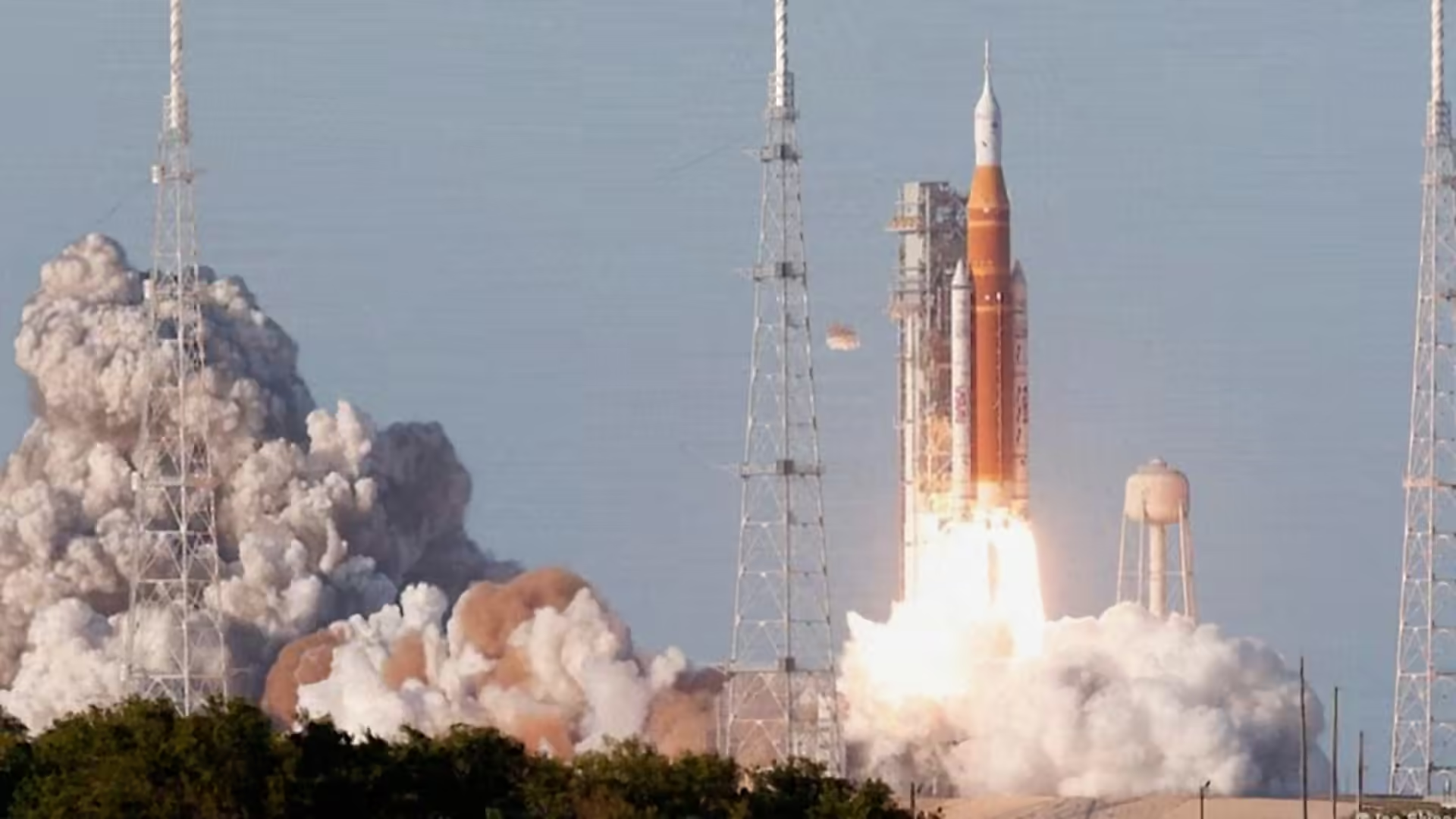
NASA launches Artemis II with four astronauts toward the Moon
The Space Launch System rocket lifted off Wednesday from Florida carrying astronauts on a 10-day orbital mission, the first crewed lunar journey since 1972.
6:51 PM
NASA's Artemis II mission successfully launched Wednesday evening from Kennedy Space Center in Cape Canaveral, Florida, sending four astronauts on a historic journey to lunar orbit for the first time in more than 50 years.
The Space Launch System rocket, standing approximately 98 meters tall, lifted off at 6:35 p.m. ET, carrying the Orion crew capsule with astronauts Reid Wiseman, Victor Glover, and Christina Koch of NASA, along with Jeremy Hansen of the Canadian Space Agency. The launch occurred within NASA's two-hour window that opened at 6:24 p.m. ET.
Wiseman, a 50-year-old former naval aviator and test pilot who previously served as subdirector of NASA's astronaut office, commands the mission. Glover, 49, also served in the U.S. Navy. Hansen is the first non-American to travel this far into space. Koch is the first woman to orbit the Moon.
The 10-day mission will take the crew approximately 250,000 miles from Earth, further than any human has traveled. The astronauts will orbit the Moon multiple times, including viewing the far side of the Moon illuminated by the Sun—a sight not seen by Apollo astronauts during their lunar missions over 50 years ago. However, no lunar landing is planned for this mission; the crew will return to Earth by splashing down in the Pacific Ocean after ten days.
Artemis II serves as a systems validation mission for NASA. The agency will use the flight to test the Orion spacecraft's life support systems, navigation, communication links, and overall performance in deep space with a crew aboard—conditions that cannot be fully replicated on Earth. The mission's power and life support module was constructed by the European Space Agency.
The launch had been delayed twice previously. The mission was originally scheduled for early February 2026 but was postponed due to a helium supply issue. Wednesday's successful launch marks the first crewed flight of the Space Launch System rocket and the first time humans have traveled beyond low-Earth orbit since Apollo 17 in December 1972.
Artemis II is part of NASA's broader Artemis program aimed at returning humans to the Moon and eventually sending astronauts to Mars. NASA recently adjusted its timeline, shifting the planned 2027 Artemis III mission from a Moon landing to a test flight, with the Artemis IV mission set for 2028 to include a lunar landing.